
Appearance
YouTube demo & tutorial
Prefer a visual-only pass first? How to play repeats the clip links up top and carries placeholder figures for tabletop stills.
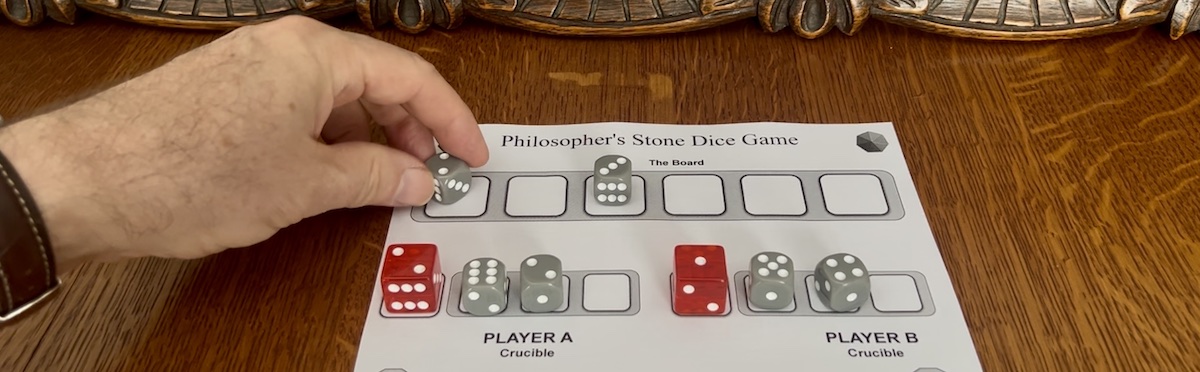
This page pairs with the full-game PSDG tutorial on YouTube (watch on YouTube): same table beats as the canonical script (draft → Poisoned Gift → Transformation → Tumble → Immortal). Use it to follow along while you watch or to replay the line without the video.
Rules (v1.13) remain the authority for edge cases and full rule text beyond this one scripted line.
Perfect play: the draft, twists, and Exchange below match the principal line from the Python reference solver for this fixed board and crystals—not an improvised line. The opening’s minimax value is +1 (A wins under optimal play); your tabletop result should agree.
About “chasing 6” on every twist
It is tempting to Twist every die toward 6 whenever it feels allowed, because 6 is a scoring top in Phase 1 and 2. Value‑optimal play still tracks your crystal top, what becomes the top after the Tumble, Immortal, and Poisoned Gift eligibility—not “show six” as a habit rule. On a die whose top is already 6, facing 6 toward yourself is not legal (6 is the top face, not a side). A fully pinned heuristic of “facing 6 whenever legal” is not a substitute for optimal play in pilot runs against an oracle opponent — see FAQ § 19 · ML — heuristic pilot.
Watch
On YouTube: youtu.be/N3j1XJp2ZsI
What this gameplay is
One fully specified six-dice game, v1.13:
- Two distinct Red Crystals in this script (A vs B poses differ—easier on video than identical Stones; seeded benchmark rows can still repeat the same pair for both players on some seeds).
- Board: tops left to right
2, 2, 3, 4, 5, 6before the draft. - All main beats: six draft picks, simultaneous Poisoned Gift / Exchange, Phase 1 scoring on tops, Tumble, Phase 2 scoring, then three Immortal tie tumbles. A wins after TB3.
The script below is the exact move sequence and score checks—canonical for the recording and this page.
This setup is not tuned to showcase blunder exploitation (e.g. B’s last-pick fork into a win): here the principal line is what you play for a clean teach-through. On other seeds and under the published protocol (late off-path twist, static vs re-solving at the Gift), the empirical snapshot shows the weaker side in the win column at non-zero rates—that’s a different lesson from this video.
Setup (before turn 1)
- Board (gray dice tops, left → right): 2, 2, 3, 4, 5, 6
- A’s Red Crystal: top 2, Facing Players 6 (bottom 5). Tuple form: (2, f6). Stays fixed until Immortal (if reached).
- B’s Red Crystal: top 1, Facing Players 2 (bottom 6). Tuple form: (1, f2). Same.
Nothing is scored in setup — Crucibles are still empty. The line below is the rule you will use later in The Reckoning (Phase 1 and Phase 2 on Crucible tops): each die scores 1 if its top is 6 or equals that player’s Red Crystal top; otherwise 0. Red Crystals don’t score in those phases. For this opening, that means A will treat 6 and 2 as scoring tops; B will treat 6 and 1. (Authority: Rules — scoring.)
Every move — follow in order
Die notation: each die is (top, facing), where facing is the number on the face toward you (Facing Players). Shorthand fN means facing N—for example (2, f6) is top 2 with 6 toward you. Red Crystals use the same pair when helpful.
Draft (6 picks)
Turn 1 — A:
A takes (6, facing 2) — top 6, 2 toward you; add to A’s Crucible.
A: (6, f2). Board tops: 2, 2, 3, 4, 5.
Turn 2 — B:
B takes (5, facing 1).
B: (5, f1). Board: 2, 2, 3, 4.
Turn 3 — A:
A takes (2, facing 1) — one of the two dice whose top is 2.
A: (2, f1), (6, f2). Board: 2, 3, 4.
Turn 4 — B:
B takes (4, facing 1).
B: (4, f1), (5, f1). Board: 2, 3.
Turn 5 — A:
A takes (2, facing 1) — the remaining die with top 2.
A: (2, f1), (2, f1), (6, f2) — two (2, f1) dice on purpose, not a typo.
Board: 3.
Turn 6 — B:
B takes (3, facing 1) — last die.
B: (3, f1), (4, f1), (5, f1). Board: empty.
Poisoned Gift (Exchange)
- A gives to B: either (2, f1) twin (same choice for video and table), oriented so B has f1 (the 1 toward B).
- B gives to A: (3, f1), oriented so A has f1.
Reveal simultaneously, swap, re-sort each Crucible low → high by top.
After swap (tops): A: 2, 3, 6 — B: 2, 4, 5.
The Reckoning
Phase 1 — Transformation (score tops: 6 or your crystal top):
- A (crystal top 2): tops 2, 3, 6 → 2 points
- B (crystal top 1): tops 2, 4, 5 → 0 points
Phase 1: A = 2, B = 0.
Phase 2 — The Tumble
Tumble each Crucible die (Facing Players → new top). Red Crystals do not tumble here.
- A: new tops 1, 1, 2 → 6 or 2 → 1 point
- B: new tops 1, 1, 1 → 6 or 1 → 3 points
Phase 2: A = 1, B = 3.
Totals: A = 3, B = 3 → Immortal Tiebreaker.
The Immortal Tiebreaker (3–3)
Crucibles stay as after Phase 2. Only Red Crystal dice move per rules.
How it resolves: After each tie tumble you score the frozen Crucible tops against each player’s current Red Crystal top (same gold rule as Phase 1 / 2). If one player is ahead, they win immediately—you do not keep tumbling. The later tumbles run only if still tied after the previous score (the rules label Tie Tumbles 2 and 3 with “Still tied?” for exactly that). If you are still level after Tie Tumble 3, the game is a draw (Immortal Verdict).
Tie Tumble 1 (tumble each Red Crystal: facing → new top):
- A’s crystal new top = 6, B’s = 2
- Score on frozen Crucible tops: A = 0, B = 0 → still tied → continue
Tie Tumble 2 — still tied? Flip crystals (bottom → new top):
- A’s crystal new top = 5, B’s = 6
- Score again: A = 0, B = 0 → still tied → continue
Tie Tumble 3 — still tied? Tumble again (facing → new top):
- A’s crystal new top = 1, B’s = 5
- Count: A uses 6 or 1; B uses 6 or 5 → A = 2, B = 0 → A wins.
“Why would A do that?” — not a blunder, not bad pedagogy
Viewers (especially a human B) can read the Poisoned Gift or Phase 2 and feel that A erred or “gave B a good die.” A few things to keep separate:
- (top, facing) vs a “bad top” — The 1 in (2, f1) is a facing (a side of the die), not a second “top” for The Transformation. Phase 1 scores Crucible tops; the facing matters when it becomes the new top at The Tumble and in Immortal, not as “an extra 1 on top” the instant the gift is revealed.
- 3–3 on total gold — A tie after the two main scorings is not a drawn game. The rules then run The Immortal until a verdict (or, after the third tie tumble, a draw in the very narrow sense of the Immortal Verdict).
- What the reference solver is optimizing — The line on this page matches a verifiable principal (value‑optimal) play sequence for this fixed board and crystals. The Python reference solver backs up win / draw / loss for the entire game, including the tiebreak steps. It does not add a second goal like “win earlier on the main scoring” or “avoid Immortal.” A script that is 3–3 on gold and then has A win in the tiebreak is therefore on-plan in that model, not a mistake because one phase looked good for the opponent. (Other value‑optimal lines on the same start can in theory finish before Immortal; this record uses one clean teach-through.)
For teaching
Contrast how the game feels after a single phase with how the defined objective and v1.13 text resolve the result—useful for the same representation point the site makes elsewhere, without anthropomorphising the solver as “A knew.”
Note for researchers
In published six-dice seeded suites (e.g. benchmark_5000_6d.json), each row stores its own a_crystal and b_crystal, sampled separately from the seed (different offsets in the generator—same idea as two independent setup rolls). Identical (top, facing) for both players can still occur on some seeds (it is not forbidden). This teach script fixes two different Stones so the tutorial is easy to follow on camera; it is not claiming benchmarks exclude matching crystals.
Closing the loop: treat this page as rules pedagogy on a verifiable principal line. For robustness / deployment numbers (when suboptimal play or static Exchange move realized outcomes), use the empirical snapshot and the blunder tooling in the repo—not this single teach line.