PSDG — Philosopher's Stone Dice Game. Even with an exact solver, a frozen plan can lose to a worse opponent — not from noise, randomness or hidden information, but because the rules decouple placement from possession. The act of choosing is long over by the time its consequences are realized. PSDG is the smallest game where this gap is exactly measurable.
A tiny deterministic game where a correct answer, a visible state, and a deployed plan can come apart.
Learn basic play in about 3 minutes — Watch on YouTube. Tiebreak / Immortal takes a few more minutes — demo & script.
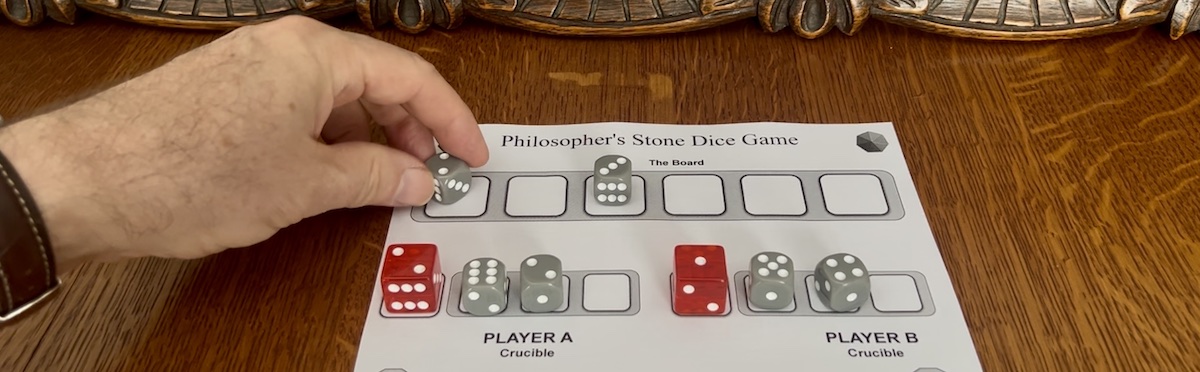
Last move for Player A, twisting dice so facing value is 3.
PSDG (Philosopher's Stone Dice Game) is a two-player dice game with an exact solver. The setup of the board is random; after that there is no randomness and no hidden information, so every position can be solved exactly. That is the point: because the ground truth is computable, PSDG is less a benchmark than an exact exhibit machine — each claim below is shown by a single board the solver labels, then, where noted, measured over seeded suites.
PSDG removes the usual excuses: no hidden information after setup, no stochastic dynamics after setup, no trained-agent approximation, and no computational uncertainty.
The distinction it isolates:
A correct answer for the expected state is not the same as a robust policy for the state that actually occurs.
A solver can compute a winning line. Freeze that line, replay it after the opponent leaves the expected path, and the winning player can lose. Re-solving from the realized state fixes it. The failure is never in the solver — it is in deploying a trajectory where a policy was needed.
Six dice are rolled onto a shared board; each player also holds a Red Crystal value.
After setup the game is fully deterministic and fully observable.
Players alternately draft dice into their Crucibles. On taking a die, a player locks its facing value (the side turned toward the players) — distinct from its current top.
Players then gift one eligible Crucible die to the opponent (the Exchange).
Phase 1 scores current tops. All dice then Tumble — each die's facing becomes its new top — and Phase 2 scores again. A tie is broken by a fixed deterministic procedure.
A die scores if its top is 6 or matches the holder's Red Crystal.
The load-bearing mechanism: a choice locked early becomes payoff-relevant later, after ownership and orientation have changed — so the current tops alone are not a sufficient description of the state. Full mechanics, tiebreaker, and the Immortal rule: rules.
Before the full game, PSDG has a one-minute version — a stripped-down bandit, not the draft-and-Exchange game above:
Three dice. One pick. One reward. The training phase rewards the top face, so the Mortal picks the highest top and scores perfectly — Q = 1.00. Then deployment scores the bottom face instead. By the Rule of 7 the highest top has the lowest bottom: the Mortal's perfect pick is now the worst. It loses.
The optimization was not the problem — the pick was provably optimal for the reward it was given. The objective was the problem: the bottom face was never secret, just never part of what the agent was asked to represent.
This is PSDG's first lesson — wrong objective, with no draft, gift, or Exchange. The exhibits below are different lessons: mostly a genuinely optimal plan, frozen and then beaten by a worse move (deployment) — plus one showing that even the visible state can be insufficient, so two identical-looking positions demand opposite moves (representation). Related, but not the same argument as the parable. Read the full parable →
Re-solving (closed-loop): at the realized state, ask "what is optimal from here?" Robust.
Frozen principal line (open-loop): keep following the line computed for the expected path. A principal line is one path through the tree — not a contingent strategy for the states that actually arise. Fragile.
Having the solver is not enough. What matters is whether the deployed agent re-queries it once the state has moved. In the headline six-dice suite, a static (frozen-line) policy derived from the exact oracle loses about 8.5% of games to a blundering opponent; re-solving on the realized state brings that to about 5.7%. The gap is the cost of freezing a plan instead of re-conditioning on the true state.
Claim: replaying a frozen line can lose a game that is provably won. Seed 58. A wins under optimal play no matter what B does. A holds (2,4),(5,1),(6,4), crystal (4,1); B holds (2,1),(6,2), crystal (1,2). B plays its last die (2,6). Static A replays the frozen gift (0,3) → −1, loses. Re-solving A plays (1,3) → +1, wins. Lesson: the solver wasn't beaten; the frozen trajectory was.
Claim: a strictly worse move by B can still beat a static A. Seed 28. B has a winning final move (2,1) → −1 (B wins) but blunders to (2,3) → +1 (A can now win). A holds (1,2),(5,1),(6,2), crystal (1,5); B crystal (5,1). Static A replays gift (0,2) → −1, loses anyway. Re-solving A plays (0,3) → +1, wins. Lesson: the blunder doesn't beat the solver — it beats the stale plan.
3 — Not all wins are equally robust (value compression) — preliminary
Claim: the {−1, 0, +1} value label hides how fragile a win is. A clean Phase-2 win and a knife-edge tiebreaker win are both labelled "+1," but they are not equally safe under deviation. In a first probe, 4 of 14 tiebreaker-thin wins collapsed under some deviation, versus 6 of 69 raw-margin wins. Status: suggestive, small sample — not yet a headline result. Lesson: a win label can conceal a thin margin.
4 — Re-solving is robust where the frozen line is not
Claim: in genuinely won positions, re-solving does not lose to a B deviation. Enumerating every legal final-pick deviation, re-solving A held the win in every genuinely-won position, while static A lost a measurable fraction by replaying a stale gift. (An earlier apparent exception was a principal-line consistency bug, since fixed: the position was genuinely won — re-solving from the opening confirms +1 on all 5,000 seeds — only the stored line was not subgame-perfect.) Lesson: a state-conditioned policy absorbs the deviation; a frozen path does not.
5 — The effect is not a six-dice artifact — preliminary
Claim: the open-loop wedge appears across board sizes. The avoidable open-loop loss rate — games a frozen line throws away that re-solving saves — is being re-derived at 4, 6, and 8 dice with the corrected (subgame-perfect) solver before the cross-board numbers are quoted here. Six dice currently looks like the highest-fragility regime. Status: 4- and 6-dice solid in earlier runs; cross-board rates under re-measurement.
6 — A tops-only view is not sufficient state (at the Exchange)
Claim: two positions that look identical in a tops-only snapshot can require opposite optimal Gifts — and the wrong one flips a provable win to a loss. From the demo opening (board 2,2,3,4,5,6, A crystal (2,6), B crystal (1,2)), two Exchange positions share the same tops — A (3,4,5), B (2,2,6) — but differ in facings. Position 1 (A (3,1),(4,6),(5,3)) needs gift top-3 → +1; the other position's gift top-4 → −1. Position 2 (A (3,6),(4,1),(5,6)) is the mirror: gift top-4 → +1, gift top-3 → −1. A tops-only agent must commit to one gift and is wrong on one of them — a maximal +1 → −1 swing. Enumerated: 4 of 14 tops-only Exchange groups conflict; the effect appears in ≈79% of random openings and is identical under win/loss, margin, and lexicographic objectives (so it is a representation failure, not objective coarseness). Full worked example, draft paths, and bare-solver verification →Lesson: facings encode Phase 2; drop them and the agent fails totally on an identifiable subset — this is aliasing, not hidden information.
Machine learning. The question is not "can a neural agent replace the solver?" but "what information and protocol does a learner need to recover the structure the solver uses?" A learner fed only surface features can fit unstable correlations; one trained only on principal-line traces imitates a single path rather than the value landscape. More on PSDG for ML.
AI safety. PSDG is a miniature of a deployment problem: a correct answer for one state can become wrong once cached and reused after the world moves off the line it was computed for. Correct computation is not the same as safe deployment. A robust agent preserves state, notices when its assumptions have changed, and re-queries. More on PSDG for AI safety.
Game theory. PSDG cleanly separates three objects often blurred together: the game value, a principal-line witness, and a full contingent strategy. A correct winning line is not a policy for every off-path state; the measurable gap is exact value versus deployment robustness. More on PSDG for game theory.
PSDG is a tiny deterministic game where exact, hand-checkable boards show that surface observations, solver traces, and deployed plans can come apart — and seeded suites measure how often they do.