
Appearance
Rules in brief
Playing for the first time? Use How to play (illustrated walkthrough; video links at top) or the linear Simple rules (players) page; this section also carries research context.
Philosopher's Stone Dice Game (PSDG) is a two-player tabletop game played with six board dice, Red Crystal dice, two Crucibles (your areas on the mat), and a small playmat or paper layout. Only setup is random—positions and crystals—then every legal move follows the rules with no extra rolls and no hidden information. Most gold after the two scoring phases (and Immortal if you are tied) wins. Table time is roughly 10–15 minutes once you know the beats.
Twist and Tumble
Twist — rotate a die without changing its top, to choose which side value faces the players (Facing Players Value in the rules below).
Tumble — rotate the Crucible dice forward (90°), away from the players, so the face that was facing the players becomes the new top.
In normal play: Twist on each draft pick; Tumble each Crucible die once in The Reckoning after Phase 1; Immortal uses Crystal (and scripted) tumbling again if you reach the tiebreaker.
Unlike chess, a snapshot of tops alone is not enough to specify the true position: the Facing Players Value you Twist when drafting is a Phase 2 commitment (it becomes the new top after the Tumble). Two configurations with the same visible tops can need opposite optimal play. After setup the game is perfect information—nothing is hidden by the rules—so the research stressor is state compression / aliasing (what a policy puts in its inputs), not partial observability in the poker sense. For the play-along scripted line (draft through tiebreaker) and the video, see YouTube demo & tutorial — youtu.be/N3j1XJp2ZsI.
- Players & gear: 2 players; 6 gray dice (shared board pool), 1 Red Crystal each (Stone); perfect information after random setup.
- Draft (alternating, A first): take a board die, Twist to set Facing Players Value—a two-phase commitment (Phase 1 scores the current top; Phase 2 scores that facing after the Tumble). You lock both before the Exchange and final scoring fully unpack—the same ready, fire, aim rhythm as on the home page; build a sorted Crucible of 3 dice.
- Poisoned Gift (Exchange): each gifts one Crucible die under eligibility (look at your 3 Crucible dice + your Red Crystal — four tops total; if any value repeats among those four, you must gift from the lowest of the repeated values; if all four tops are different, you may gift any Crucible die; you never gift the Crystal). Choose the facing your opponent receives; reveal simultaneously in v1.13 play; re-sort Crucibles. Examples: among those four tops, 2, 2, 4, 5 → you must gift a 2; 2, 3, 5, 5 → you must gift a 5; 1, 3, 4, 6 (all different) → any Crucible die. Research: core ML / safety lessons—and the minimal parable (no Exchange at all)—do not depend on simultaneous reveal; see NOTE — simultaneous Exchange.
- Scoring (“what is gold?”): each Crucible die scores 1 if its top is 6 or equals your Red Crystal top; else 0. Red Crystal never scores in main phases. Phase 1 score tops; Tumble each Crucible 90° forward; Phase 2 score again; higher total wins.
- Immortal tiebreaker: if still tied after Phase 2, Crucible dice stay frozen while a scripted sequence of Red Crystal tumbles and flips rescores them until verdict or draw. Benchmark: on the published 5,000-game principal-line suite, about 72% of games are decided after Phase 2 with no Immortal (tiebreak depth table).
- Research hook: Canonical v1.13 continues below on this page—edge cases, seating, Gift procedure, and alternative Exchange variants in research benchmarks. Pinned rules make positions exactly evaluable; proxy and deployment failure modes are oracle-measurable, not theoretical only. Public solver, benchmarks, and canonical rules (Markdown) live in github.com/Rob-McCormack/psdg —
RULES.mdmatches this page; see also Solver & GitHub on the home page.
The sections below are the full v1.13 rulebook (kept in sync with RULES.md in the public repository).
Philosopher's Stone Dice Game
PSDG · v1.13 · 2 Players · Ages 8+ · 10–15 Minutes
Date: February 23, 2026
Two rival alchemists. One legendary stone. The power to turn lead into gold.
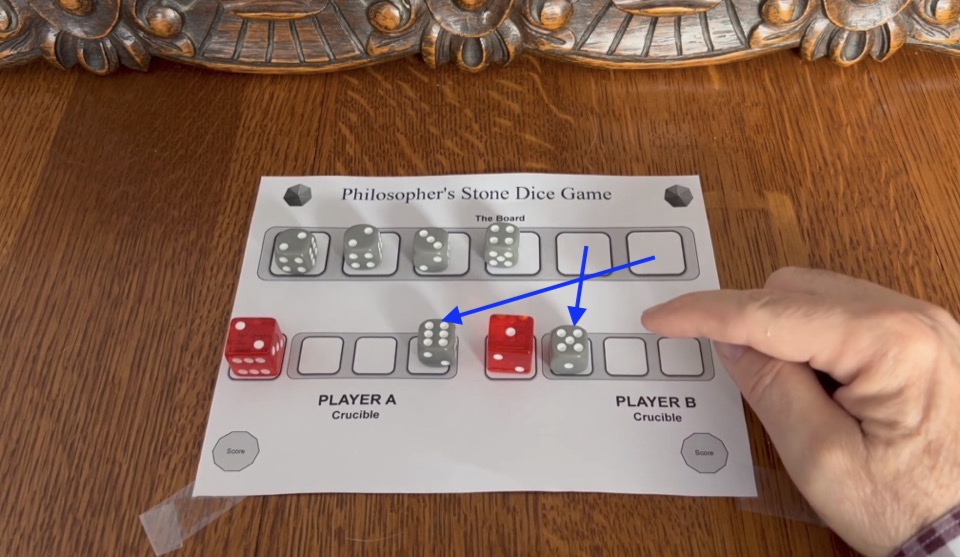
Middle Game Shown Here.
The Legend
The Philosopher's Stone is a legendary red crystal sought for millennia by alchemists because of its ability to turn lead into gold and to grant immortality.
Overview
Philosopher's Stone Dice Game is a game of transformed treasure, treachery, and poisoned gifts. Once the board is set, your luck never runs out—because you never had any to begin with.
Play long enough and you'll realize what mathematics already confirms: without perfect foresight, no strategy is unbeatable.
What Makes a Die Gold?
This is the one rule everything else is built on. Learn it now.
Each of your 3 Crucible dice scores 1 point if its top value is:
- 6 — pure gold, always
- Equal to your Red Crystal die's top value — transmuted by the Stone
Any other value is lead — it scores 0. Your Red Crystal die itself never scores. Maximum: 3 points per phase.
Your Red Crystal die's top value is fixed throughout Phase 1 and Phase 2. It only changes if the game reaches The Immortal Tiebreaker.
You score twice — once before The Tumble, once after. Your total is both phases added together.
Components
- 6 gray dice — the Board, your shared draft pool
- 2 Red Crystal dice — one per player, the Philosopher's Stone
- 2 yellow dice — optional practice dice (see Tips below)
- 2 ten-sided dice — optional score trackers for tournament play
- Case — a small metal mint container used to hold everything
Facing Players Value — the value on the side of a die facing the players. You choose this each time you place or orient a die.
To Twist — rotate a die without changing its top value. You are choosing which side is the Facing Players Value.
To Tumble — rotate a die 90° forward, away from you. The Facing Players Value becomes the new top value. This is how lead transforms into gold — or doesn't.
Setup
Determine First Player
Each player rolls one die. The highest roll becomes Player A and goes first. If tied, re-roll until one player wins.
Preparing the Board
Both players sit side-by-side on the same side of the table, facing the Board. Everything is visible to both players at all times.
Setting the Red Crystal Dice
Each player has their own Red Crystal die. Set it randomly before play:
- Roll your Red Crystal die to set its top value.
- If the top is 6, roll again until you get 1, 2, 3, 4, or 5.
- Before moving the die, note the Facing Players Value — the value on the side most directly facing you. If it's unclear which side faces you, roll again.
- Place your Red Crystal die to the left of your Crucible, with the Facing Players Value facing you. The Facing Players Value is used only if the game reaches The Immortal Tiebreaker.
The Red Crystal die never moves again during normal play.
Setting the Board
Player A and Player B each roll 3 gray dice. Arrange all 6 dice in a row from lowest to highest top value, with some space between them so sides are visible. This is the Board.
The Draft — Refine Your Crucible
Players alternate turns starting with Player A. On each turn:
- Take any die from the Board
- Twist it — choose the Facing Players Value. This is your two-phase commitment: Phase 1 scores the current top value; Phase 2 scores the Facing Players Value after The Tumble. Choose both with intention
- Place it in your Crucible, kept sorted from lowest to highest top value, left to right
Continue until all 6 dice are claimed — 3 per player.
The Poisoned Gift — The Exchange
Once the Board is empty, both players must give one Crucible die to their opponent — and choose the Facing Players Value their opponent receives.
Which die must you give?
Look at all 4 of your dice: your 3 Crucible dice and your Red Crystal die.
- If any top values repeat among your 4 dice, you must gift a Crucible die from the duplicate set with the lowest top value
- If all 4 top values are unique, you may gift any Crucible die
- You can never gift your Red Crystal die
Example: Your 4 dice show top values 2, 3, 5, 5 — you must gift a die showing 5. Your 4 dice show top values 2, 2, 4, 5 — you must gift a die showing 2.
Poisonous System Gift
Sometimes the harm at the Exchange comes from the system—the eligibility rules—not only from the opponent’s intent. The Poisoned Gift is always part of the game, but duplicate tops among your Crucible dice and Red Crystal can restrict which die you are allowed to gift, sometimes forcing a transfer you would not choose if every Crucible die were eligible.
That is a structural trap: a line that looks good for immediate, visible scoring can also create a duplicate pattern that narrows your options later. It also helps explain off-path brittleness in the benchmarks: a blundering opponent may produce a configuration that exposes the weakness of a frozen, solver-derived policy tuned to a tidy principal storyline.
For learning systems, the same pattern appears at a high level: maximizing the obvious metric can create the conditions for a later disadvantage—here through eligibility and the machinery of the Gift, not through missing a single tactical trick from the other player.
How to reveal
Cover your Crucible with one hand. With the other, select your gift die, hold its top value steady, and Twist it to set the Facing Players Value your opponent will receive. When both players are ready, reveal and exchange simultaneously. Re-sort both Crucibles after the exchange.
::: note NOTE — Research claims do not depend on simultaneous Exchange Consumer v1.13 uses simultaneous reveal at the Gift. Research benchmarks also publish sequential Exchange variants (B moves after seeing A’s gift, etc.).
What does not depend on simultaneity: the main ML and AI-safety arguments—proxy rewards vs latent tiebreakers, irrevocable draft commitments, static vs re-solving at the Exchange, misreported state, and the blunder / deployment tables. In the standard 5,000-game suite, the sequential static-A row already shows higher B win rates than the simultaneous row, so removing simultaneity does not defang the commitment story.
The minimal parable: the Mortal vs Oracle parable uses no Exchange at all—only a regime change after training. Its “optimal on proxy, fail when the true rule fires” lesson is orthogonal to whether the full game’s Gift is simultaneous or sequential.
What simultaneity does add in the full game is a clean game-theoretic node (mixed strategies, Nash at a simultaneous move)—material for game theory, not a prerequisite for the headline safety or ML diagnosis. Longer argument: AI safety — Simultaneous Exchange and the safety thesis. :::
The Reckoning
Phase 1 — The Transformation
Score your 3 Crucible dice using their current top values. Apply the scoring rule above. This is the first test — how much gold did you claim in the draft?
Phase 2 — The Treacherous Tumble
Now the hidden futures are revealed. Tumble each of your 3 Crucible dice — rotate each 90° forward so the Facing Players Value becomes the new top value. Your Red Crystal die stays still. Score your Crucible dice again using their new top values. Apply the scoring rule once more.
Add both phases together. Highest total wins.
The Immortal Tiebreaker
If both totals are equal, the Stones themselves decide. Your Crucible dice stay locked in their Phase 2 positions throughout.
Tie Tumble 1: Tumble each player's Red Crystal die away from you. The Facing Players Value of your Red Crystal die becomes its new top value. Score your Crucible dice against that new top value using the scoring rule.
Tie Tumble 2: Still tied? Flip each Red Crystal die over — the bottom becomes the new top. Score again.
Tie Tumble 3: Still tied? Tumble each Red Crystal die away from you once more — the current facing rises to become the new top. Score again.
The Immortal Verdict: Higher score wins. If still tied after all three Tumbles, the game is a draw.
Tips
Opposite faces always sum to 7. This means when Twisting a die, the one value you cannot choose as your Facing Players Value is always 7 minus the top value. Experienced players use this to calculate options without physically rotating the die.
Use the yellow dice to learn. Hold one while studying the Board and Crucibles, practicing the Twist and Tumble freely until the movements feel natural.
Using the ten-sided dice for scoring. Use these to track cumulative scores across multiple games — best of three, best of five, or any tournament format. A single die counts 0–10, but the mint tin extends its range: placed on the open lid it reads as 10 plus the shown value; placed inside the tin it reads as 20 plus the shown value — giving a range of 0–30 per die.
Alternative Seating
Once familiar with the game, players may sit opposite each other across the table. Each player places their Crucible to their own right, ensuring the top value and Facing Players Value of each die remain visible to both players at all times.
PSDG · Perfect Information · Deterministic After Setup · v1.13
In PSDG, unbeatable play requires perfect foresight.