
Appearance
PSDG for Game Theory — At a Glance
On this site: Home · Game theory (full) · FAQ · ML · Empirical snapshot
The load-bearing lesson is **not** that minimax “fails”—it’s that **realized outcomes** hinge on **what stays frozen** vs **what gets recomputed** once play leaves the principal line. With exact values in hand, you can separate **solving** the extensive form from **deploying** a policy inside it.
The blunder table’s rows are **not** three rival refinements of one unconstrained extensive form—they index **how the midgame exchange is run**: what you **commit** to before legibility catches up, and **who moves when** at that node.
**Formally:** “optimal” realised outcomes are **joint with deployment protocol \(P\)**, not pinned by the abstract tree alone. **\(P\)** separates **static** principal-line play vs **re-solving** on the realized branch; **sequential vs simultaneous** timing there is another axis (it moves the **static** row, not the re-solving story).
Learn basic play in about 3 minutes — Watch on YouTube. Tiebreak / Immortal takes a few more minutes — demo & script.
The result: Against oracle-derived static A, strictly worse B wins between ~5.7% and ~8.5% depending on (P) — roughly ~8.5% sequential static · ~6.9% simultaneous static · ~5.7% with re-solving at the Gift. Same suite, pinned seeds; (P) picks which row. Contrast: timing at the Gift explains ~8.5% vs ~6.9%; re-solving explains the drop to ~5.7%. See: Empirical snapshot · pinned definitions.
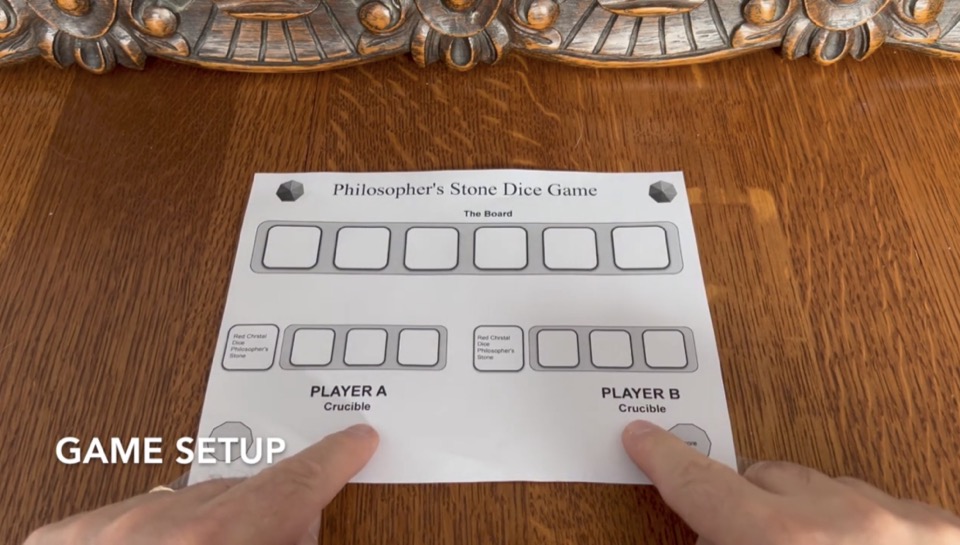
The Playmat
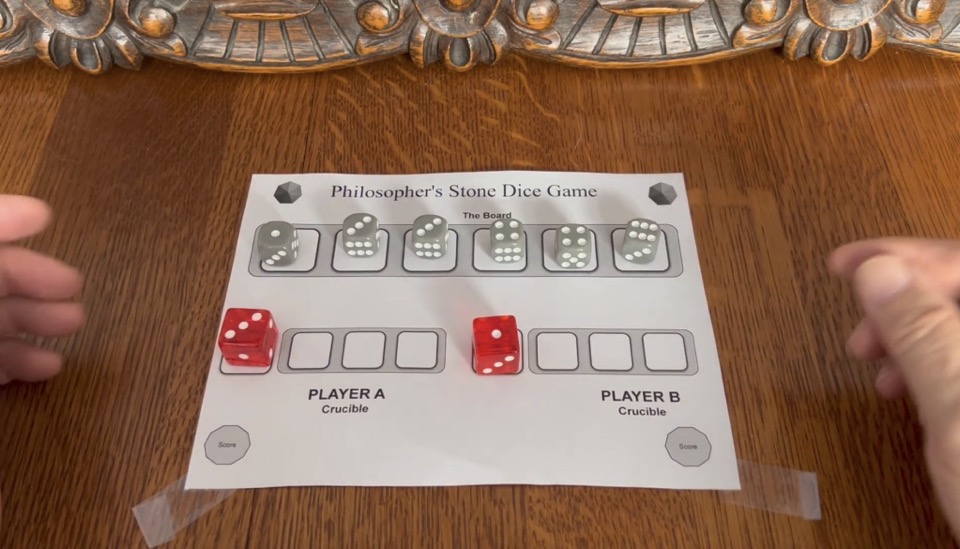
The complete board after initial setup; deterministic play begins here.
The mechanism: After deviation, ex post payoff depends on whether A commits to the principal-line Gift or re-solves, and whether the Gift node is played sequentially or simultaneously. The oracle stays consistent under a fixed embedding; the stress test is whether deployment tracks the realized tree. Twist commitments land before later phases make all scoring rules legible—so a coarse “tops only” summary can merge nodes the full tree keeps distinct, even under perfect information after setup.
Why this matters to game theory (and adjoining fields):
- Ex ante plans can lose ex post after the “wrong” opponent — Whether you stick to the principal-line gift or re-optimize on the realized node is not cosmetic; on seeded suites it is a reported split (~8.5% / ~6.9% / ~5.7% story), not a footnote about off-path theory.
- Order at the exchange moves the static row — ~8.5% vs ~6.9% is who chooses when under frozen play; re-solving is the other coordinate down to ~5.7%—conflating the two axes misreads the table.
- If you call every row “optimal,” you merge different objects — Optimal, blunder, and better ex post under (P) are pinned labels here; vocabulary slip turns distinct claims into one fuzzy headline.
See: Deployment gap · Representation / deployment / simultaneity · Pinned definitions · FAQ — named classes · Commitment before legibility (aside)
Deeper Dive:
- Game theory — full analysis — extensive form, deployment figure, ~5.7% row, relation to standard theory
- Pinned definitions — optimal / blunder / ex post under (P)
- ML / evaluation — regret and reporting keyed to this geometry
- AI safety — simultaneous Exchange thesis — what does not depend on simultaneity
- Empirical snapshot — full table
- Technical report — commitment before legibility
If you take one thing:
Can you name the deployment protocol under which your “optimal” claim holds — and what happens to it after off-path play?
Detailed report: Technical report (summary)