
Appearance
Game in two minutes
Learn basic play in about 3 minutes — Watch on YouTube. Tiebreak / Immortal takes a few more minutes — demo & script.
What this is: a game-only skim. Canonical rules, eligibility, Immortal script, and research notes live on Rules (v1.13). Illustrated walkthrough: How to play · Linear players’ text: Simple rules (players).
PSDG
Philosopher's Stone Dice Game
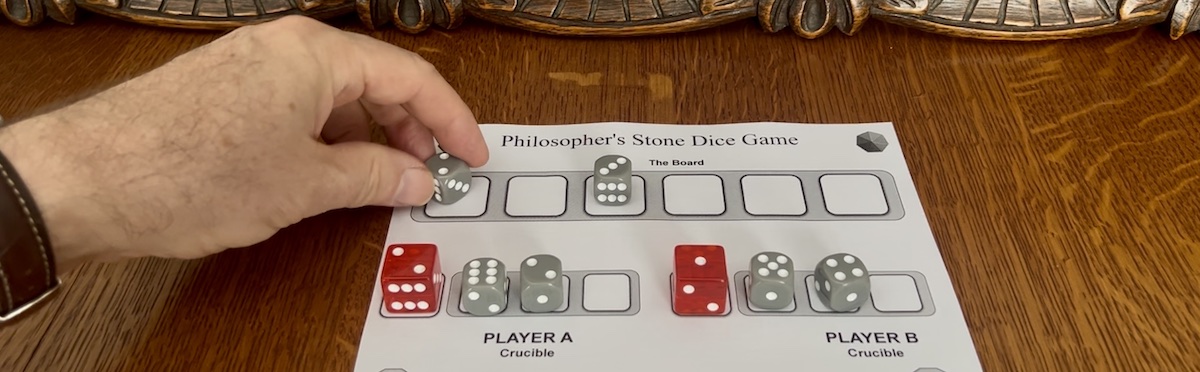
Six gray dice sit on a shared board. Each player has one Red Crystal die and a Crucible area (your row of three drafted dice). That’s the physical setup.
Setup is the only randomness: roll the six board dice and both Crystals (v1.13 rerolls a Crystal that shows 6 on top). After that: no hidden information and no further rolls.
Goal: Most gold after two scoring phases. A Crucible die scores 1 if its top is 6 or matches your Crystal top; else 0.
Draft: Players alternate moving board dice into their Crucibles without rerolling tops. Each pick you Twist: keep the same top, rotate the die so you choose which side faces both players (Facing Players Value). That side matters later—not only for Phase 1 tops.
Poisoned Gift (Exchange): Each player gifts one eligible Crucible die to the opponent (duplicate-top eligibility is pinned on Rules). Table v1.13 defaults to simultaneous reveal; benchmarks also vary sequential vs simultaneous timing.
Phase 1: score tops.
Tumble: each Crucible die rotates forward once (~90°, away from the players); the facing you chose becomes the new top.
Phase 2: score again using those tops.
Tiebreak: If still tied after Phase 2, the Immortal tiebreak (the rules’ name for a short deterministic script on the Crystals while Crucibles stay frozen)—full steps on Rules.
Structural point: During the draft you commit facing values that are not fully readable off Phase‑1 tops alone. Two positions can share the same Phase‑1 tops yet need different Twists, because facings encode different Phase‑2 futures.
Benchmark (one line): After off-path play, published rows contrast re-solving at the realised Exchange node vs statically replaying the principal-line gift under a pinned protocol—see the empirical snapshot and game theory.
At this zoom level, that’s the whole object.
Next: Rules (full) → · How to play (stills + video) → · Home →